


May 2nd, 2026
Video Installation at Hasbrouck Park
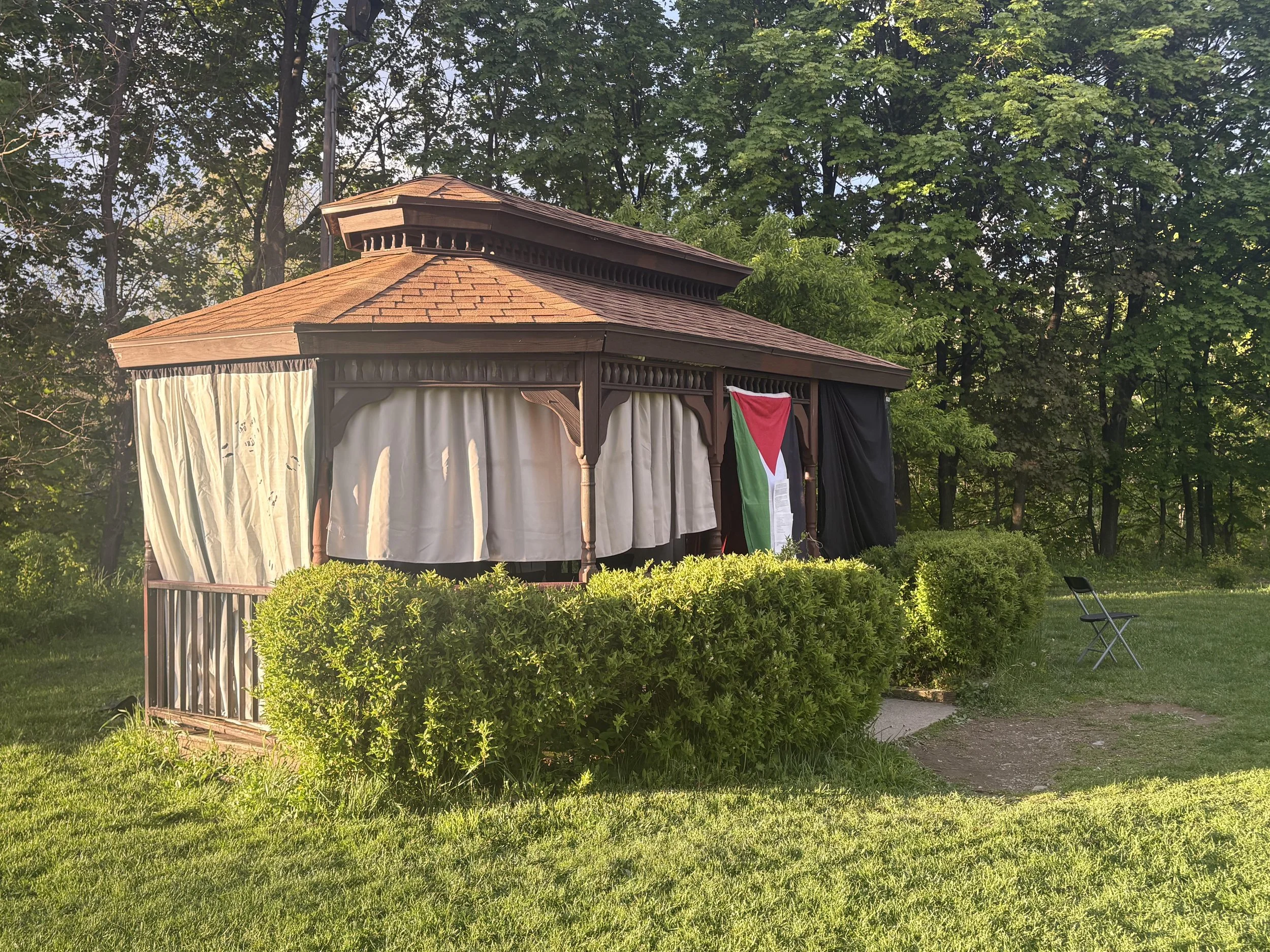
Two years ago today, on May 2nd 2024, New York State Police and the Ulster County Sheriff's office raided the Gaza Solidarity Encampment and arrested 133 students and community members. This was one of the highest number of arrests at a single school for the entire spring. A letter signed by over 120 SUNY Faculty decried the excessive use of police force which led to hospitalization, concussion and the arrest of a news reporter.
Extended Cut of May 2nd Footage by Alex Young
State troopers arrived with drones, helicopters, riot gear and K9 units and proceeded to tear apart and then bulldoze the encampment which began on May 1st and had been peaceful and in compliance with SUNY’S demands. Details of the night & this trauma are explained in a class action lawsuit made against SUNY President Darrell P. Wheeler in his individual capacity, Sheriff Juan Figueroa, in his individual capacity, NY State Police, Ulster County Sheriff’s office and the New Paltz state police for excessive force and unlawful arrest. Currently this lawsuit is still underway as a motion to dismiss was denied.
Our film production company Baggysuit has put together this installation screening because we feel May 2nd is critically under examined in local discourse and the state repression that occurred here and across the nation during the spring of 2024 informs our current moment of chilled campus dissent and increased surveillance and repression against those protesting ICE.
This installation further seeks to contextualize this event by exploring the occupation of an administration building by students that occurred after the Kent State Massacre in May 1970, and how SUNY NP President Neumaier's response to student protests differed drastically from the course taken by current President Darrell Wheeler. We also further examine the demands of the student protesters and how SUNY New Paltz contracts can be tied to the Israeli occupation of the West Bank. Two years out it is vital that we keep the conversation alive regarding Palestine and the crushing of student activism on campus.
- James Hyland
Table of Contents
FIG. 1 Phone photos and videos of May 1st & 2nd.
FIG. 2 Footage from faculty meeting.
FIG. 3 Video regarding 1970’s occupation.
FIG. 4 Footage of May 2nd + Interviews.
FIG. 5 Video regarding SUNY’S contracts with Siemens.
FIG. 6 2024 Student Demands.
FIG. 7 1970 Matzdorf letter to the editor.
FIG. 8 1971 Neumaier resignation letter.
FIG. 9 Excerpt from Oracle article about 1970 Protests.
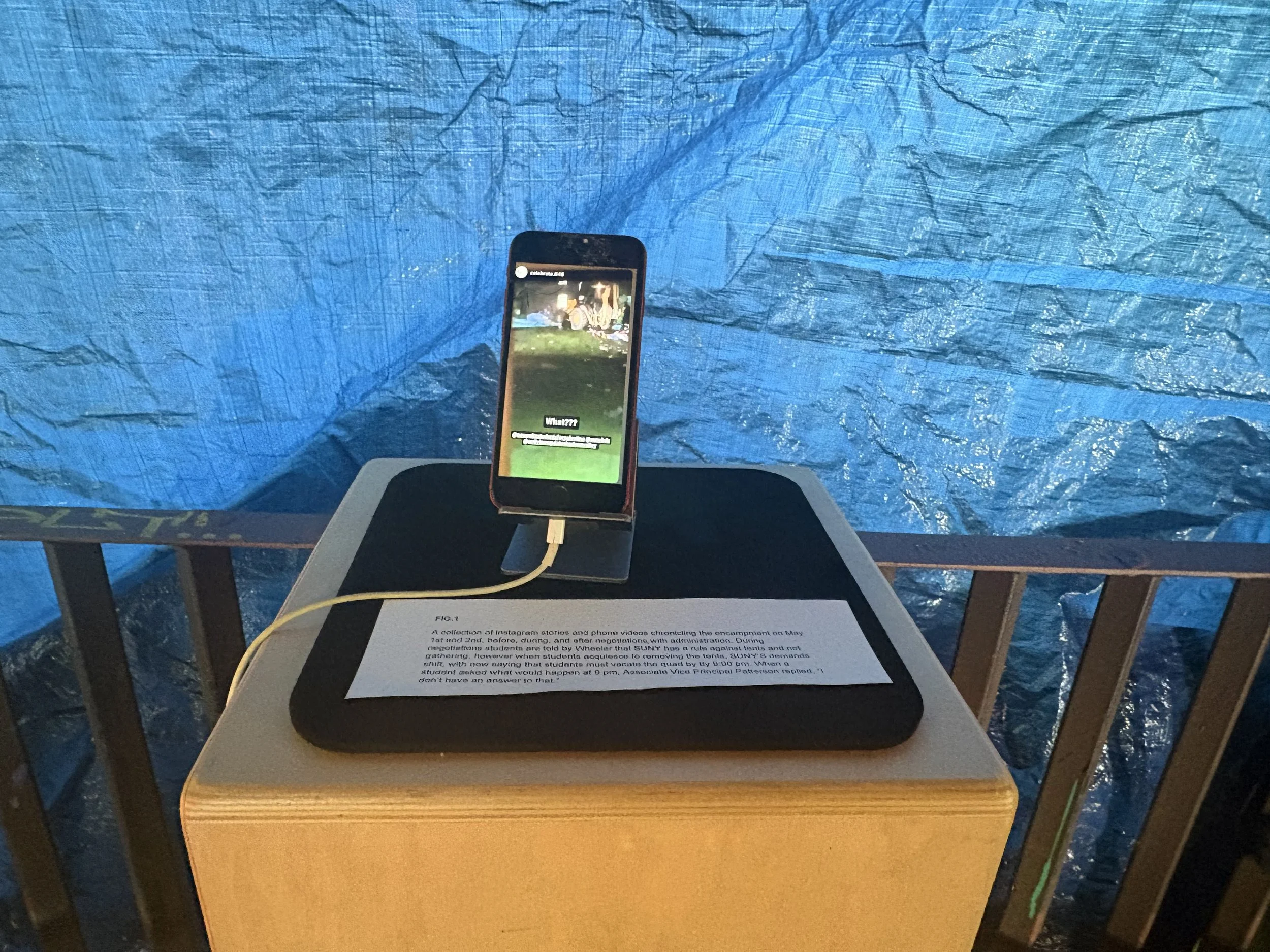
FIG.1
A collection of Instagram stories and phone videos chronicling the encampment on May 1st and 2nd, before, during, and after negotiations with administration. During negotiations students are told by Wheeler that SUNY has a rule against tents and not gatherings, however when students acquiesce to removing the tents, SUNY’S demands shift, now saying that students must vacate the quad by by 9:00 pm. When a student asked what would happen at 9 pm, Associate Vice Principal Patterson replied, “I don’t have an answer to that.”
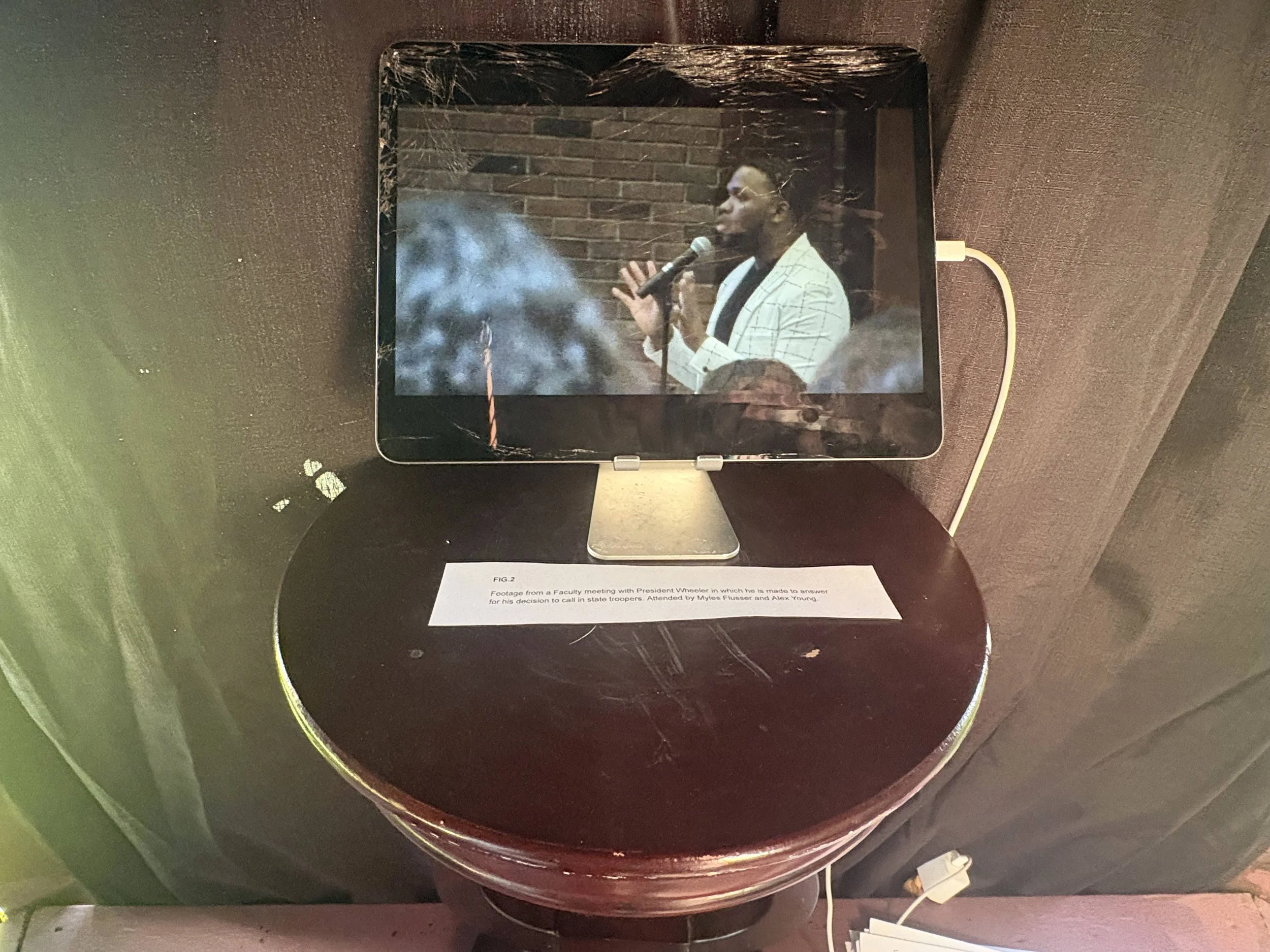
FIG.2
Footage from a Faculty meeting with President Wheeler in which he is made to answer for his decision to call in state troopers.
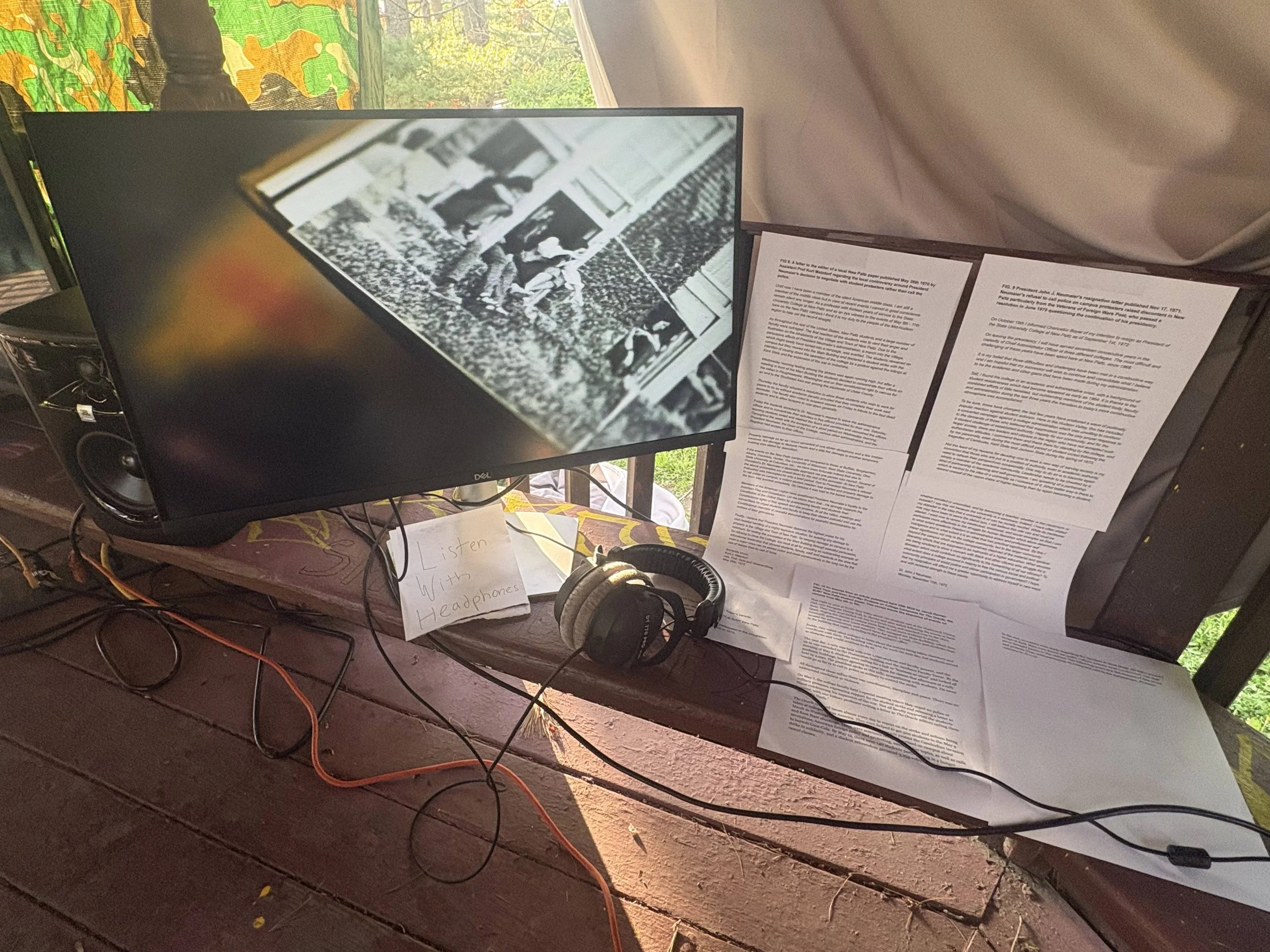
FIG. 3
SUNY New Paltz 1970 Yearbook sourced from the Rogers family.
An audio recording from an anti-war rally held May 5th 1970 at SUNY New Paltz, sourced from the Elting Memorial Library.
An interview with Ron Simon, a community member who participated in the occupation of the administration building after the Kent State massacre in 1970.
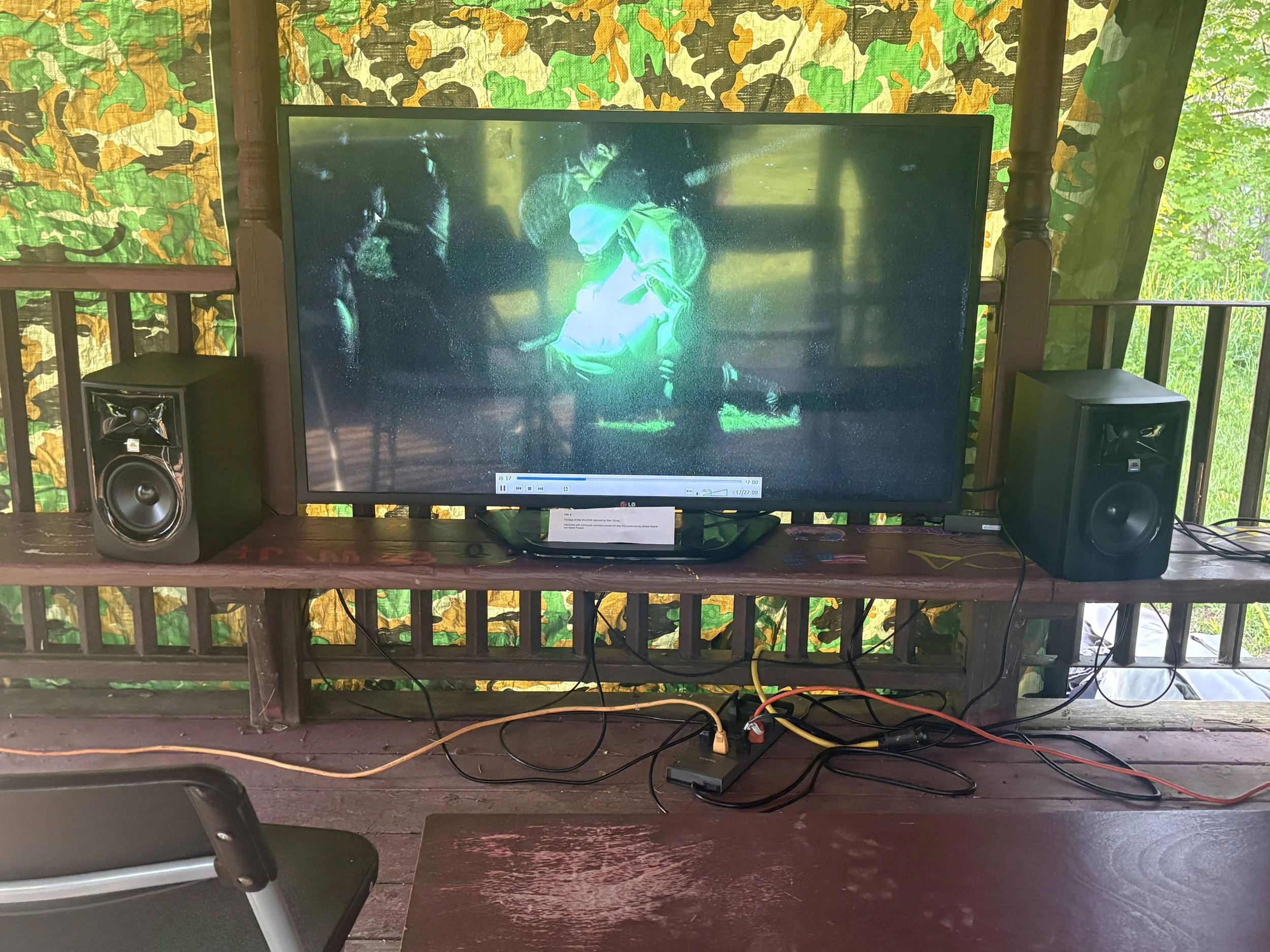
FIG. 4
Footage of May 2nd 2024 captured by Alex Young.
Interviews with community members present on May 2nd conducted by James Hyland and Myles Flusser.
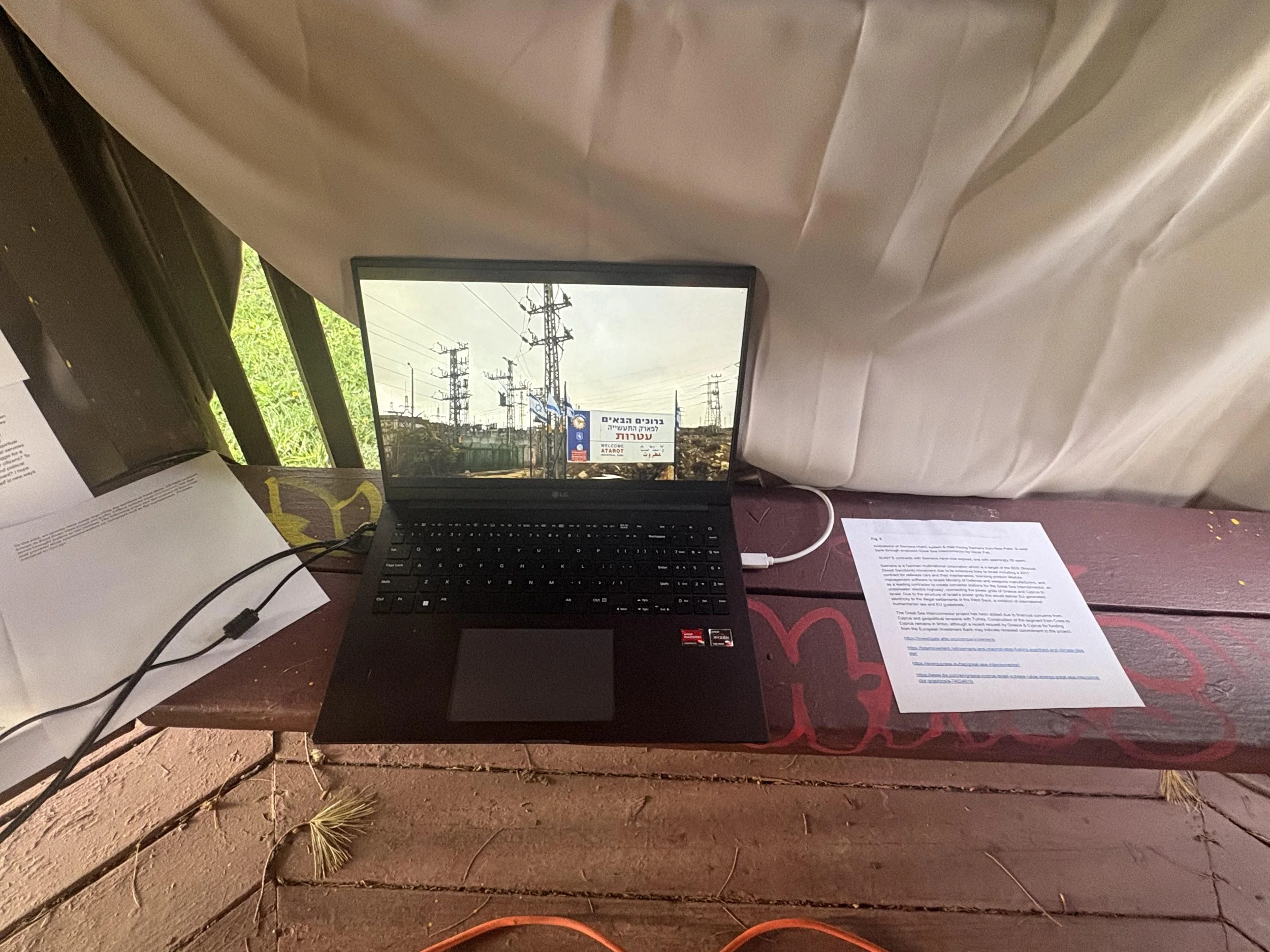
FIG. 5
Animations of Siemens HVAC system & map tracing Siemens from New Paltz to west bank through proposed Great Sea Interconnector by Oscar Pak.
SUNY’S contracts with Siemens have now expired, one with seemingly 0$ spent.
Siemens is a German multinational corporation which is a target of the BDS (Boycott Divest Sanctions) movement due to its extensive links to Israel including a 2017 contract for railways cars and their maintenance, licensing product lifestyle management software to Israeli Ministry of Defense and weapons manufacturers, and as a leading contractor to create converter stations for the Great Sea Interconnector, an underwater ‘electric highway’, connecting the power grids of Greece and Cyprus to Israel. Due to the structure of Israel’s power grids this would deliver EU generated electricity to the illegal settlements in the West Bank, a violation of international humanitarian law and EU guidelines.
The Great Sea Interconnector project has been stalled due to financial concerns from Cyprus and geopolitical tensions with Turkey. Construction of the segment from Crete to Cyprus remains in limbo, although a recent request by Greece & Cyprus for funding from the European Investment Bank may indicate renewed commitment to the project.
https://investigate.afsc.org/company/siemens
https://bdsmovement.net/siemens-and-chevron-stop-fueling-apartheid-and-climate-disaster
https://energypress.eu/tag/great-sea-interconnector/ https://www.dw.com/en/greece-cyprus-israel-subsea-cable-energy-great-sea-interconnector-graphics/a-74024610
FIG. 6
2024 Student’s Demands
1 - Disclose
SUNY New Paltz must disclose all its donations, investments, and contracts. All financial dealings with private companies must be made freely and publicly accessible via online search. This information must also be sent via email to all New Paltz students.
2 - Divest
SUNY New Paltz must sever contracts, withdraw investments, and end all financial relationships with companies responsible for genocide in Palestine, including immediate termination of Siemens contracts C991285 and OC42022.
3 - Disengage
SUNY New Paltz must adopt an ongoing position of non-engagement with all companies named by the Palestinian BDS movement.
4 - AMNESTY
SUNY New Paltz must drop all academic sanctions placed on students as a result of their participation in the encampment. In addition, the University must absolve all faculty members who have been put under investigation for speaking out about Palestine.
For more information, read this Oracle article: Remembering May 2nd
FIG. 7
A letter to the editor of a local New Paltz paper published May 28th 1970 by Assistant Prof Kurt Matzdorf regarding the local controversy around President Neumaier’s decision to negotiate with student protesters rather than call the police.
Until now I have been a member of the silent American middle class. I am still a member of the middle class but in view of recent events I cannot in good conscience remain silent any longer. As a professor with thirteen years of service to the State University College at New Paltz and as an eye witness to the events of May 5th - 11th here on the New Paltz campus I think it is my duty to the people of the Mid-Hudson region to help set the record straight.
As throughout the rest of the United States, New Paltz students and a large number of faculty were outraged. The first reaction of the students was to vent their anger and frustration on the inhabitants of the Village and Town of New Paltz. Due to the persuasive efforts of President Neumaier’s administration, a march into the Village, which might easily have turned into a rampage, was averted. The students remained on campus but they moved into the Main Building and declared a student strike with the intention of closing down the operation of the college as a protest against the killings at Kent State and the expansion of the war in Indochina.
Wednesday morning feeling among the strikers was again running high, but after a meeting in front of the Main Building the students decided to concentrate their efforts on the rallies in Poughkeepsie, Washington and on their constitutional right to canvas for an end to the Southeast Asia war among the electorate of Ulster County.
Thursday the faculty adopted a resolution to allow those students who wish to work for peace to do so without academic penalty provided that they complete their work next semester. The faculty also voted to suspend classes on Friday in tribute to the four dead students and to allow tempers to cool down generally.
Friday the students acceded to Dr. Neumaier’s request to leave the administrative offices and to concentrate their activities in five offices provided for their use. Saturday morning students swept and washed the floors and corridors and vacuumed the offices. Throughout the week with the exception of a short period on Wednesday morning, President Neumaier, the Dean of the College, various other administrators, and the Registrar had access to their offices.
Property damage as far as I know consisted of one stolen dictaphone and a few broken windows, fire damage to Mohonk House and a little fire damage to another temporary building also slated for demolition.
If the events on the New Paltz campus are compared to those at Buffalo, Binghamton, Albany, Columbia, Hunter, The University of Wisconsin, Kent State University, Ohio State University at Columbus, etc., we have been fortunate indeed that due to President’s Dr. Neumaier’s diplomatic approach not one person was injured. Several of the above universities are closed down for the rest of the semester. At New Paltz instruction was interrupted for only a brief period. Due to President Neumaier’s refusal to call police on campus, a violent student reaction was averted and property damage to the town was avoided completely. On campus it was kept to the barest minimum.
Members of the American Legion have questioned President Neumaier’s loyalty to the American Flag and Constitution. Let me inform them that…He strongly supports the Constitution of the United States by guaranteeing faculty and students their Constitutional rights of free speech and due process. At all the rallies, meetings and conventions he urged students and faculty to keep their dissent peaceful and use the Constitutional channels of peaceful demonstrations for peaceful demonstration for redress of their grievances.
Finally, I believe that President Neumaier deserves the highest praise for his cool-headed handling of a highly explosive situation, for averting any damage to property in the Village and Town of New Paltz, for keeping damage on campus to a minimum, for ending the occupation of the Main Building through peaceful persuasion, for refusing to close the College, but most of all for providing an outstanding example of educational leadership that showed students, faculty, staff and residents in the area that even a major crisis can be solved better and more constructively in the long run by the use of reason than by use of force.
Sincerely yours,
Kurt J. Matzdorf
Ass. Prof. Gold and Silversmithing
May 28th, 1970
FIG. 8
President John J. Neumaier’s resignation letter published Nov 17, 1971. Neumaier’s refusal to call police on campus protesters raised discontent in New Paltz particularly from the Veterans of Foreign Wars Post, who passed a resolution in June 1970 questioning the continuation of his presidency.
On October 19th I informed Chancellor Boyer of my intention to resign as President of the State University College at New Paltz as of September 1st, 1972.
On leaving the presidency, I will have served seventeen consecutive years in the capacity of Chief Administrator Officer at three different colleges. The most difficult and challenging of these years have been spent here at New Paltz, since 1968.
It is my belief that those difficulties and challenges have been met in a constructive way and I am hopeful that my successor will wish to continue and consolidate what I believe to be the academic and other gains that have been made during my administration.
Still, I found the college in an academic and administrative crisis, with a background of student resistiveness which had become apparent as early as 1964. It is thanks to the combined efforts of little heralded, but outstanding members of the student body, faculty and administration during the last three years the transition to today’s more constructive atmosphere was accomplished.
To be sure, times have changed; the last few years have produced a wave of politically popular reaction against student activism. Here in the Hudson Valley, this has included a concerted campaign against a college administration which was unwilling to conform to the demands of those who believed that suppression was the only proper response to a student challenge of established authority. Happily for our community, and for the larger society, there are leaders and citizens in the region who have not accepted such authoritarian attitudes. I commend them and thank them for standing by the college, and by me personally, even during the most difficult period of student unrest following the tragedies of Cambodia, Kent State and Jackson State during the spring of 1970.
Not the least of my reasons for deciding now to seek a new way of serving society is my conviction that those who are put in a position of authority, even in academic authority, need to refresh their perspectives occasionally. One way to do so is to become again simply a member of the academic community. Leadership needs to be checked by a kind of partnership in learning and self-governance. I am speaking of a partnership which is central to the idea of a university as I conceive of it. What better way is there to remind oneself of the raison d'etre of higher learning than by again becoming a student, whether enrolled or unenrolled, and by becoming a teacher, whether in the classroom or outside? I say this not because the university is a sanctuary; indeed, I have often stated my disbelief in the idea that a university is or can be morally neutral. While its traditional role may have been to serve the status quo, I still believe this role can and must be altered. I want now to renew my intellectual, emotional, and social energies so that I can participate more effectively in the struggle for human liberation which alone determines to what extent academic freedom is administrative sham and professorial self indulgence and to what extent it is an ideal that has practical significance. By this I mean significance not only to the college community, but to the larger community beyond the campus which remains comparatively deprived of the material and spiritual liberating efforts that are supposed to be hallmarks of a higher education. What services are being rendered to show a concern with Black and other citizens who struggle for a liberation which could contribute so significantly to the humanizing of all our citizens? To what extent does a college succeed in helping to free the various social and political community principles of social justice and citizen participation in government? I hope that my resignation will afford me a greater opportunity to address myself in new ways and with renewed strength to these issues.
Dr. John J Neumaier,
Monday, November 15th, 1972
FIG. 9
An excerpt from an article published April 25th 2024 by Jacob Kamen titled Then and Now: Anti-War Protests on College Campuses for The Oracle, the SUNY New Paltz student paper. This except traces the sequence of events on campus from May 4th to 9th.
That night in 1970 at SUNY New Paltz, about 150 students met at the Hasbrouck Dining Hall, now Peregrine Dining Hall, to discuss and plan action following the events at Kent State. They were soon kicked out due to a bomb scare and marched over to the Main Quad, ringing fire alarms in various dorm halls to call more students to action, eventually gathering over 1,000 students. They occupied the Main Building, which then housed the administration, and stayed there for nearly a week. Over 500 students slept in the building that night, including in the president’s office.
Inside, they called other colleges to learn about the actions being taken elsewhere and coordinate with them. The building was open for work the next day, but students served as obstacles and would continue to do so.
The next day, a rally was held with over 1,000 students and faculty present, and the sit-in was extended to the Humanities building and the Jacobson Faculty Tower. By the morning of May 6, students were calling for a halt to “business as usual” and locked all academic buildings, before agreeing to open them for classes that afternoon at a rally held by 2,000. The president spoke at this rally, sympathizing with students. He never would go as far as to call in police or military to control the strike.
All throughout these rallies there was coordination, discipline and peace. There was no widespread vandalism or violence.
On May 7, the college faculty held a special meeting where they urged no police or military presence, expressing support for the student strike and releasing a letter to Nixon condemning his expansion of the war. Not all faculty supported the students however, with one history professor writing a letter to The Oracle editors calling them “New Paltz Nazis.”
The Oracle released issues almost every day to report on the strike and actions being taken at colleges across America. They even helped to get 500 students to the May 9 March in Washington, which saw over 100,000 people protest the Cambodian invasion and Kent State shootings. There were seminars being advertised on campus about revolutions, American foreign policy and protesting, among other topics, as well as calls to boycott Coca-Cola. By May 12, there were 140 students participating in a hunger strike in solidarity, and a student referendum garnered 3,259 voters, deciding 7-3 to cancel classes.
In the end, no arrests were made regarding the incident at Kent State. All eight accused troops at Kent State were found not guilty. Officer actions were condemned, but that never brought justice to the victims. The following years saw the erasure of this event and protests from commemoration on campuses and in the mainstream. Protests continue to disrupt.